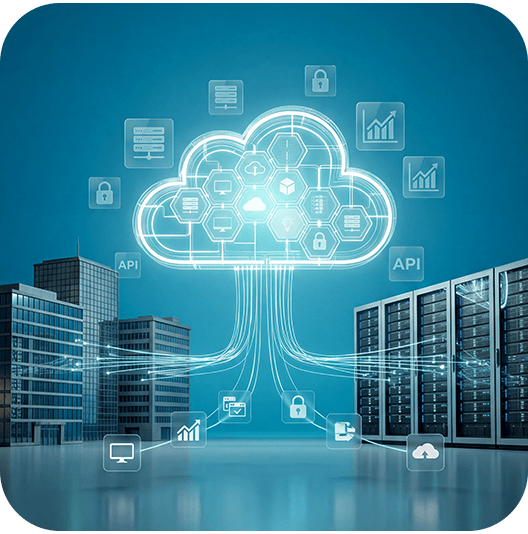

Cloud vs On-Premises Infrastructure: Which is Right for Your Business?
Cloud infrastructure provides scalable, on-demand computing resources delivered over the internet, while on-premises infrastructure relies on physical servers and hardware owned and maintained by an organization. The right choice depends on factors such as business objectives, security requirements, scalability, budget, compliance, and long-term IT strategy.
For many organizations, choosing between cloud and on-premises infrastructure is no longer simply an IT decision it is a strategic business decision.
As businesses expand their digital capabilities, launch new customer services, and adopt technologies such as artificial intelligence (AI), analytics, and automation, infrastructure must support increasing workloads while remaining secure, reliable, and cost-effective.
While traditional on-premises infrastructure continues to play an important role, many organizations are modernizing through Enterprise Cloud Solutions that provide greater flexibility and scalability without requiring continual investment in physical hardware.
Rather than asking “Which is better?“, organizations should ask:
“Which infrastructure model best supports our business objectives?”
Understanding Cloud Infrastructure
Cloud infrastructure delivers computing resources such as virtual servers, networking, storage, security, and management services through a cloud platform.
Instead of purchasing and maintaining physical hardware, organizations can provision resources when needed, scale them as demand changes, and support business growth without significant infrastructure expansion.
Modern cloud platforms combine services such as Elastic Cloud Servers (ECS) storage, networking, and security into a single environment that can support both traditional enterprise applications and modern digital workloads.
Understanding On-Premises Infrastructure
On-premises infrastructure consists of physical servers, networking equipment, storage systems, and software installed and managed within an organization’s own facilities or private data centers.
Organizations maintain complete ownership and operational control over the environment, including hardware procurement, maintenance, upgrades, security, and capacity planning.
This model can be suitable for legacy applications or specialized workloads that require direct control over physical infrastructure.
Cloud vs On-Premises Infrastructure
Feature | Cloud Infrastructure | On-Premises Infrastructure |
Infrastructure Ownership | Cloud provider manages infrastructure | Organization owns and manages hardware |
Scalability | On-demand resource scaling | Capacity limited by installed hardware |
Initial Investment | Lower upfront investment | Significant capital expenditure |
Deployment Speed | Rapid provisioning | Hardware procurement and installation required |
Maintenance | Managed cloud services | Internal IT teams manage hardware |
Business Continuity | Built-in resilience and backup options | Requires dedicated planning and investment |
AI Readiness | Easily supports scalable CPU and GPU resources | Requires additional hardware investment |
Flexibility | Resources can scale with demand | Expansion requires purchasing new hardware |
Benefits of Enterprise Cloud Infrastructure
Scalability
Organizations can increase or decrease infrastructure resources based on changing business requirements without purchasing additional servers.
Enhanced Security
Leading enterprise cloud platforms integrate multiple layers of security across networking, compute, storage, and identity management, helping protect business-critical workloads.
Faster Innovation
Cloud environments enable faster deployment of applications and services, allowing businesses to respond more quickly to changing market conditions.
AI Readiness
Modern organizations increasingly require infrastructure capable of supporting AI, analytics, and machine learning. Platforms designed for AI Infrastructure provide scalable CPU and GPU resources that allow businesses to adopt these technologies without investing in dedicated hardware.
Business Continuity
Cloud infrastructure simplifies backup, replication, and disaster recovery strategies. Organizations looking to strengthen resilience often combine cloud environments with Backup & Disaster Recovery solutions to minimize operational disruption.
Benefits of On-Premises Infrastructure
Although cloud adoption continues to grow, on-premises infrastructure still offers advantages in specific situations.
Complete Physical Control
Organizations maintain direct ownership and management of hardware, networking, and physical security.
Legacy Application Support
Older enterprise applications that were not designed for cloud environments may continue to operate effectively on existing infrastructure.
Specialized Operational Requirements
Certain workloads with highly customized hardware or operational dependencies may remain better suited to on-premises deployments.
Is Hybrid Cloud the Best of Both Worlds?
For many enterprises, the answer is not choosing one model over the other.
A hybrid cloud strategy combines on-premises infrastructure with cloud services, enabling organizations to modernize at their own pace while protecting previous technology investments.
For example, customer-facing applications, analytics platforms, or disaster recovery environments may operate in the cloud, while certain legacy systems remain on-premises.
Organizations that also require greater control over where critical business data is hosted may consider a Sovereign Cloud strategy as part of their long-term infrastructure roadmap.

When Should Organizations Consider Cloud Infrastructure?
When Should Organizations Consider Cloud Infrastructure?
- Modernize aging infrastructure
- Improve scalability
- Launch new digital services
- Strengthen business continuity
- Support remote and distributed workforces
- Adopt AI and advanced analytics
- Reduce hardware procurement cycles
- Accelerate digital transformation initiatives
Table of Index
Frequently Asked Questions
Answers to common questions about cloud versus on-premises infrastructure.
Both models can be highly secure when properly designed and managed. Security depends on architecture, governance, monitoring, and operational practices rather than the deployment model itself.
Cloud infrastructure can reduce capital investment and improve operational flexibility. Actual savings depend on workload design, resource utilization, and long-term planning.
Yes. Many organizations adopt a phased migration strategy by moving selected applications while maintaining existing on-premises systems.
Hybrid cloud combines on-premises infrastructure with cloud services, allowing organizations to use both environments together.
Yes. Modern cloud platforms provide scalable CPU and GPU resources capable of supporting AI, machine learning, and analytics applications.
Cloud infrastructure supports organizations across banking, healthcare, manufacturing, government, retail, education, logistics, and many other industries.
Yes. Cloud platforms support backup, replication, and disaster recovery strategies that help organizations recover more quickly from unexpected disruptions.
The decision should consider business objectives, security requirements, scalability, compliance, operational capabilities, and long-term digital strategy.
Key Takeaways
- Cloud and on-premises infrastructure each offer unique advantages.
- Infrastructure decisions should align with business goals rather than technology trends.
- Hybrid cloud provides flexibility for organizations modernizing existing environments.
- Cloud infrastructure supports scalability, resilience, and AI readiness.
- Choosing the right infrastructure strategy creates a stronger foundation for long-term digital transformation.
Who powers the Indus Cloud ecosystem











Ready to Modernize Your Enterprise Infrastructure?
Whether you’re planning a cloud migration, expanding digital services, or preparing your organization for AI-driven innovation, Indus Cloud provides enterprise-grade cloud infrastructure designed to support your business today and into the future.